
Metal Real-Time Rendering
Hardware ray-traced ambient occlusion and shadows, order-independent weighted-blended transparency, and Metal-accelerated viewport rendering on Apple Silicon. Rendering & Export →
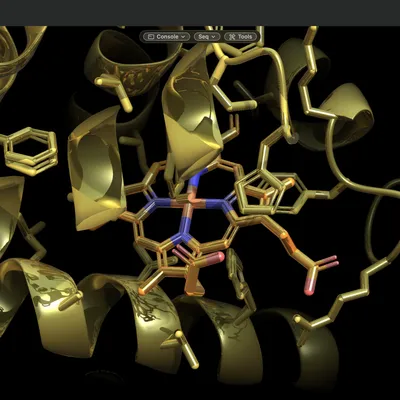
Metal Real-Time Rendering
Hardware ray-traced ambient occlusion and shadows, order-independent weighted-blended transparency, and Metal-accelerated viewport rendering on Apple Silicon. Rendering & Export →
Materials & Looks
Physically inspired materials per layer (matte, plastic, metallic, glass, marble, clay and more) and one-click Looks such as Gold, Chrome and Marble. Materials & Looks →
Studio Lights (beta)
Up to six spot lights you place around the molecule, each with its own colour, beam and shadow, shining through haze and floating dust. Not yet in a released version. Studio Lights →
Structure Prediction & Design
Run state-of-the-art ML models on-device with MLX, including Boltz-2 and (on macOS) Protenix structure prediction, alongside ProteinMPNN sequence design. Structure Prediction →
PyMOL Engine & Python
The genuine open-source PyMOL core with an embedded Python 3.13 runtime, PyMOL .pse sessions, and familiar command syntax.
Commands & Python API →
AI Control via MCP
A built-in Model Context Protocol server connects AI assistants directly to RayMol to inspect molecular scenes, select residues, and execute commands. Available in the direct-download macOS build (Homebrew/DMG). MCP setup →
Analysis Notes & Glycobiology
Document observations with 3D camera and scene links, inline #tags, and live residue/contact/measurement inserts, alongside native SNFG 3D glycan symbols and topology analysis. Analysis Notes →
Native Across Apple Platforms
A unified SwiftUI and Metal interface tailored for macOS desktop workflows, iPad touch interaction, and iPhone inspection on the go. Installation →